SIRIS-Project, Preliminary results of the 2025 excavation campaign
Areal Spring Sanctuary East (SSE)
Location of the cuts in the area of the source sanctuary
In 2025, two trenches were dug in the area of the eastern spring sanctuary (SSE 01 & 02) to clarify details about the extent, dating, and stratigraphy of the so-called East Temenos. The so-called East Temenos is a building in the eastern part of the sanctuary, consisting of fieldstone walls to the north, east, and west, which has been dated to the late Archaic period (530 BC post quem) based on excavations in the 1970s and 1980s.
Complete profile of SSE01
Although the continuation of the eastern wall of the so-called East Temenos could not be found in SSE 01 as expected, a complete profile of the geological layers down to the bedrock was uncovered for the first time in this area. This complete picture of the geological strata in the area south of the East Temenos not only helps to better understand the geological situation in the sanctuary, but also reveals for the first time a natural boundary of the sanctuary in this area towards the south.
SSE02 upon reaching the first layers of the votive deposit
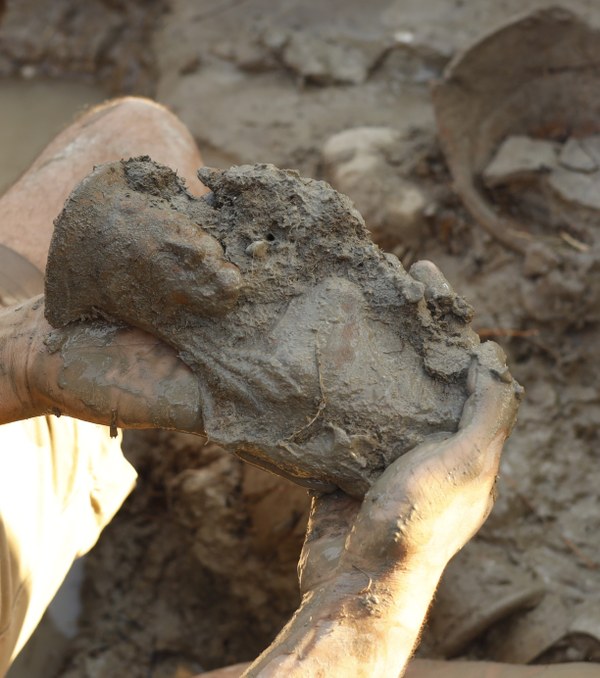
SSE 02 was established in the northeast corner of the eastern temenos in order to record the stratigraphy and possible earlier phases of the area. The work proved particularly difficult, as most of the archaeological layers were located below the waterline of the still active spring. Nevertheless, the discovery of a predecessor wall, a votive deposit with several well-preserved vessels, and a high-quality terracotta statuette of a goddess provided important insights into the use of the site in archaic times. At the same time, the finds raise new questions that will be clarified in future campaigns.
Terrakotta-Statuette einer Göttin aus dem Votivdepot in SSE 02
Areal Collina South (CS)
Location of the section on the southern collina.
The main objective of the CS trench was to identify and, if possible, date the remains of an Archaic city wall. A section of this wall had already been uncovered by Dinu Adamesteanu in 1978, although it was never fully published. The trench of the 2025 campaign was positioned a few meters (ca. 7 m) to the south of Adamesteanu’s excavation area.
Profile through the archaic mud brick wall.
During the 2025 excavation, a horizontal layer composed of river stones was discovered. Above this layer, several finds were recovered that could be interpreted as unbaked mudbricks. The general orientation and elevation of this deposit correspond to those of the structure identified by Adamesteanu. Whether the wall itself was actually reached during this season’s campaign cannot yet be confirmed. It is, however, highly probable that the ongoing analysis of the excavation results, together with future fieldwork conducted within the framework of the SIRIS Project, will help to clarify this issue.
In addition, a pottery fragment datable to the end of the 8th century BCE was found during this year’s campaign. This represents the earliest find so far discovered on the Acropolis of Siris in connection with the wall. However, the chronology of the layer in which this fragment was discovered remains uncertain, pending the ongoing study of the associated material.
The next fieldwork campaign will take place from the 16.03.2026 - 14.04.2026 and expand on the aforementioned open research questions at SSE and CS.